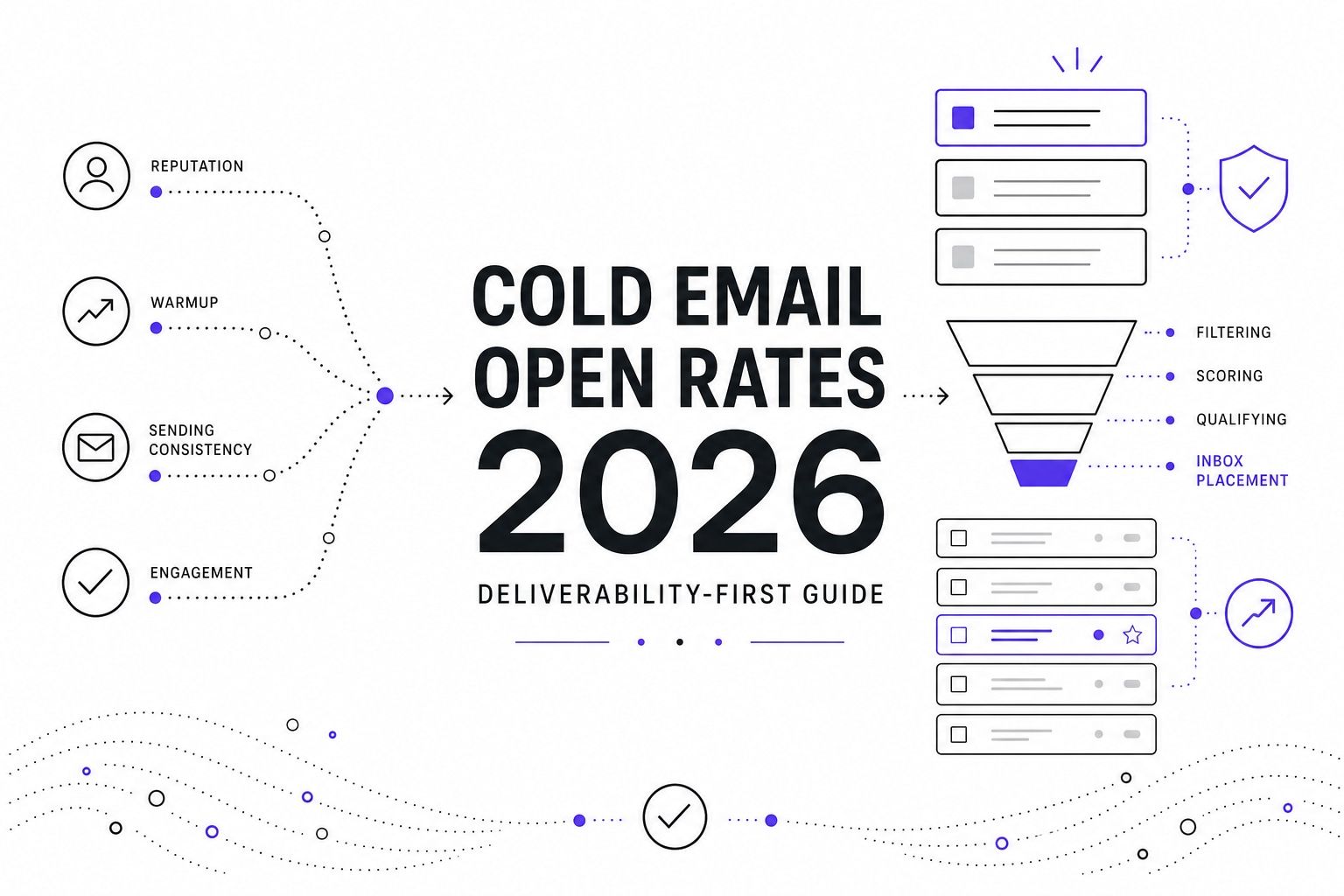
Boosting cold email open rates in 2026: a practical deliverability-first guide
Deliverability-first steps to raise cold email open rates in 2026: warmup, list hygiene, cadence, content, and inbox tests.
Boost cold email open rates in 2026 by earning inbox placement
In 2026, “open rate” is less of a vanity metric and more of a proxy for inbox placement. With tighter provider enforcement, stronger filtering, and more privacy-related measurement noise, the fastest way to lift opens is to make sure your message reliably reaches the primary inbox—and looks like a real, wanted email when it gets there.
1) Fix the foundation: inbox placement beats clever subject lines
If your emails land in spam (or get throttled), subject line testing won’t save you. Before you optimize copy, confirm these basics:
- Authenticate correctly: SPF + DKIM + DMARC aligned to the domain you send from.
- Use a dedicated sending domain (or subdomain): Keep outreach reputation separate from your main corporate domain.
- Match “From” identity to reality: Real name, real mailbox, consistent organization signals.
- Keep infrastructure clean: Correct MX/DNS setup, no accidental forwarding loops, no shadow ESP configurations.
Open rates rise when providers see a stable identity and predictable, low-risk behavior. If you’re troubleshooting why campaigns “look good” but still don’t get opened, start by measuring deliverability inputs such as bounces, spam complaints, and inbox placement. This guide on improving cold email delivery rate is a solid checklist for diagnosing where opens are being lost before the inbox.
2) Warm up mailboxes like you mean it (and keep warming up)
In 2026, new domains and new mailboxes are treated cautiously. The goal of warmup isn’t to “game” filters—it’s to build a realistic sending history with natural-looking engagement.
What good warmup looks like
- Gradual volume ramp: Start small and increase weekly, not overnight.
- Two-way interactions: Replies, short threads, and occasional forwards are stronger than one-way blasts.
- Consistency: Regular daily sending beats big spikes followed by silence.
A warmup tool can automate this safely across major providers and track whether your messages reach the inbox or drift toward spam. Mailwarm is built specifically for that deliverability-first workflow: it automates daily activity, supports Gmail and Outlook ecosystems, and focuses on building sender reputation with inbox placement visibility—useful when you’re trying to lift opens in a measurable way.
3) Keep list quality brutally high (opens drop when bounces rise)
Open rates often fall for a simple reason: you’re sending to addresses that aren’t deliverable or aren’t relevant. In 2026, providers quickly penalize patterns that look like poor list hygiene.
Practical rules for cleaner outreach lists
- Verify before you send: Remove invalid and risky addresses (especially role-based inboxes when possible).
- Separate risky segments: If you must email older leads, do it from a different mailbox and at lower volume.
- Watch bounce types: Hard bounces should approach zero; repeated soft bounces can become a reputation drag.
Even small bounce rate improvements can translate into better inbox placement, which is where open rates are really won.
4) Control volume and cadence to avoid throttling
Cold email open rates in 2026 are tightly connected to sending patterns. When you send too many emails too quickly—or increase volume without a reputation “runway”—you trigger deferrals, rate limits, or silent filtering.
Cadence practices that protect opens
- Send in business hours for the recipient’s timezone: Better timing improves engagement signals early.
- Keep daily volume per mailbox realistic: Multiple smaller mailboxes usually outperform one “high-volume” mailbox.
- Use mailbox rotation intentionally: Rotation isn’t a hack; it’s a way to distribute volume and maintain consistent reputation per sender.
If you scale via multiple inboxes, ensure each mailbox has its own warmup history and consistent sending behavior. Sudden changes (new templates, new targeting, new links, new volume) are what often cause open rates to drop overnight.
5) Reduce spam signals in content (without writing “robot-safe” emails)
“Spammy copy” is rarely one word. It’s usually a pattern: aggressive claims, heavy formatting, too many links, mismatched identity, and generic personalization. Your goal is to write emails that feel like normal business communication.
Content moves that typically increase opens
- Keep the subject line plain: Avoid hype, all-caps, and odd punctuation. Clarity beats cleverness.
- Minimize links: In many cold emails, zero links performs best for inboxing; add a link only when it’s truly necessary.
- Use a real signature: Name, role, company, and a simple line that matches your domain.
- Short first email: 60–120 words is often enough. Long emails invite scanning, not opening.
Also, don’t underestimate formatting: plain text or “light HTML” is typically safer than heavily designed templates for cold outreach.
6) Improve engagement signals the right way
Mailbox providers learn from what recipients do: open (where measurable), reply, delete, move to spam, or ignore. While opens are imperfectly tracked, replies and sustained engagement still matter a lot.
How to nudge positive engagement
- Start with a tight ICP: Relevance is the strongest “deliverability tactic” you have.
- Personalize the first line with restraint: One specific detail is better than five shallow tokens.
- Ask one low-friction question: Yes/no or a simple choice tends to generate replies.
- Follow up politely: A short follow-up that adds context often recovers opens from the first send.
If you want the engagement side quantified, pair open-rate tracking with metrics that correlate more directly with reputation (reply rate, spam rate, unsubscribe rate, and inbox placement tests).
7) Measure what’s real: opens are noisy, inbox placement isn’t
In 2026, open tracking is affected by client-side privacy features and image loading behavior. So treat open rate as directional, not absolute. To know whether your improvements work, use a layered measurement approach:
- Inbox placement tests (seed lists across providers) to see where messages land.
- Provider-specific errors (deferrals, throttles, blocks) to detect reputation issues early.
- Segmented performance by mailbox, domain, offer, and lead source.
When open rates drop, don’t immediately rewrite the subject line. First confirm whether you lost inbox placement. This deeper reference on inbox placement benchmarks and best practices for cold emails is useful for separating “copy problems” from “deliverability problems.”
8) A simple 14-day open-rate lift plan for 2026
Days 1–3: Stabilize
- Audit SPF/DKIM/DMARC alignment and From/reply-to consistency.
- Verify your list and remove risky segments.
- Reduce links and simplify templates.
Days 4–10: Build predictable sending history
- Warm up each mailbox gradually and send consistently.
- Keep daily volumes steady; avoid sudden jumps.
- Target a narrow ICP to improve early engagement.
Days 11–14: Optimize for engagement
- Test two subject lines, but keep the body stable.
- Test one variable at a time (offer, CTA, or first line).
- Monitor inbox placement and replies alongside opens.
This plan works because it prioritizes reputation and inboxing first—then improves the likelihood your subject line is even seen.
FAQ
How does Mailwarm help increase cold email open rates in 2026?
Mailwarm improves sender reputation through automated warmup activity and inbox placement visibility, helping more outreach land in the inbox where opens can happen.
Should I rely on open rate to judge success if I’m using Mailwarm?
Use open rate directionally, but pair it with inbox placement and reply rate. Mailwarm’s deliverability focus helps you see whether low opens are a tracking issue or an inboxing issue.
How long should I warm up a new mailbox before launching outreach with Mailwarm?
It depends on your starting reputation and target volume, but plan for a gradual ramp over days to weeks. Mailwarm supports progressive daily activity so you can scale without sudden spikes.
Can Mailwarm fix low open rates caused by bad lead lists?
It can’t make invalid addresses valid, but it can protect reputation once you clean your list. Combine Mailwarm with verification and tighter targeting to improve inbox placement and opens.
What’s the fastest way to improve open rates with Mailwarm without changing my copy?
Lower daily volume per mailbox, warm up consistently, remove high-bounce segments, and reduce links in the first email—then monitor inbox placement changes as you ramp back up.